
Where the Gods Chose to Linger
Naxos, Sifnos & Milos:
A Slow Journey Through the Sacred Cyclades
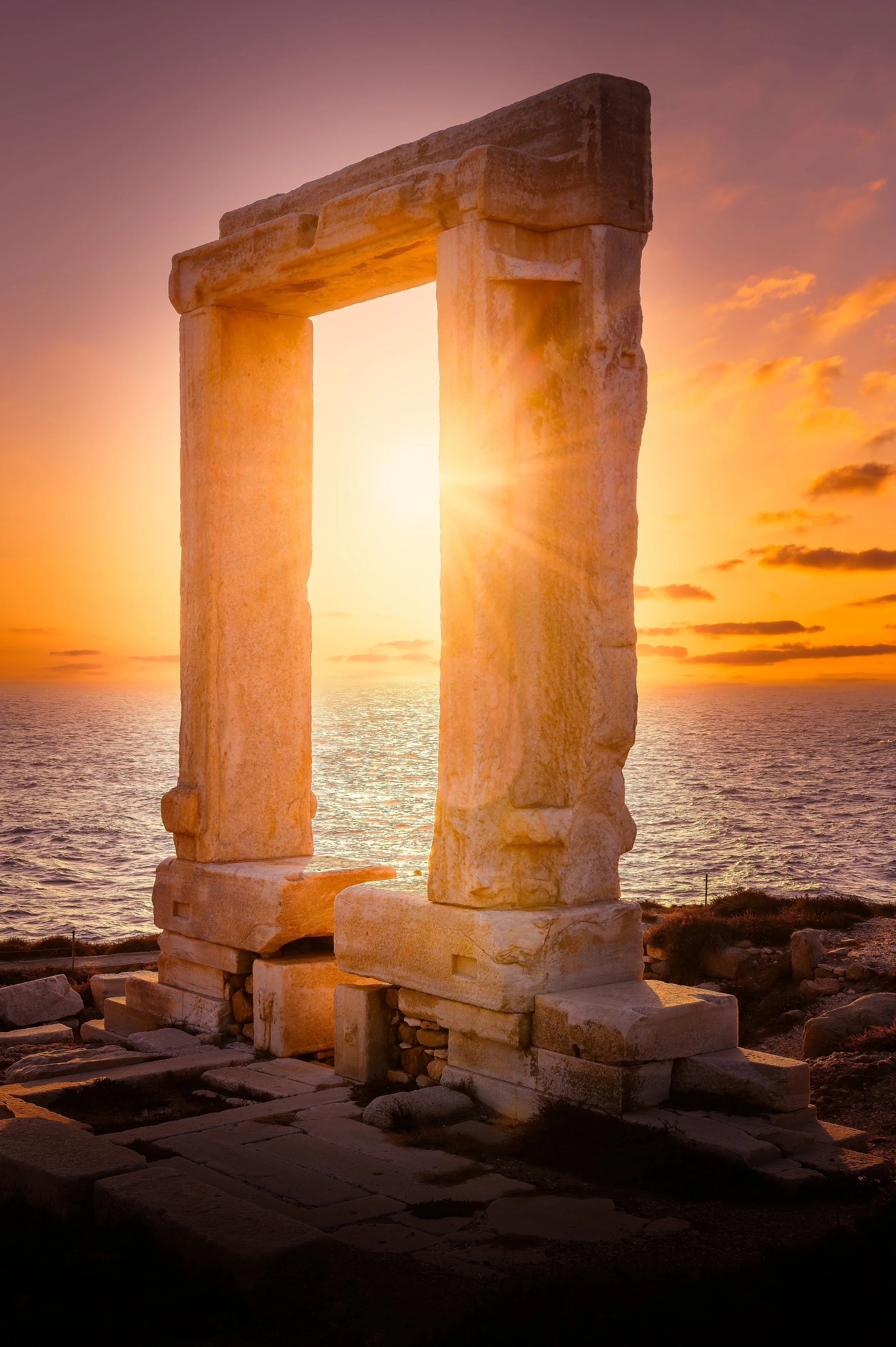
The Portara of Naxos - an ancient gate framing the Aegean
There is a line in Tennyson's Ulysses that has stayed with us since we first began imagining this journey: "all experience is an arch wherethro' gleams that untravell'd world, whose margin fades for ever and for ever when I move." It is a poem about the pull of the sea, the ache of curiosity, the refusal to stop looking—and it might as well have been written about the Aegean.
Because the Aegean does not invite. It calls.
Not loudly, and not to everyone. But to those who feel its pull, the response is almost involuntary—a turning toward light, salt, stone, and time. The Cyclades are not a backdrop to history. They are the history. And they were not stumbled upon. They were chosen—by gods, by sailors, by entire civilizations—the way certain places always are: not for convenience, but for something closer to reverence.
This is a journey into that kind of place.
The Cyclades - A Circle with a Sacred Center
The name itself tells you something. Kyklos - the Greek word for circle. The Cycladic islands were named not for their shape or size, but for their arrangement: they form a loose ring around the sacred isle of Delos, the mythological birthplace of Apollo and Artemis.
Delos was so holy that no one was permitted to be born or die on its soil. Think about that for a moment. An entire geography organized around reverence—an island so sacred that the most fundamental human experiences were forbidden there, lest they diminish its purity.
The ancient Greeks didn't just worship the land. They oriented themselves around it. They built their temples, charted their trade routes, and told their stories in relationship to Delos. And when you enter the Cyclades today, you can still feel that pull. A kind of gravitational hush. The sense that you have entered a world still shaped by an ancient instinct: the belief that certain places deserve our attention more than our ambition.
Naxos - The Island That Fed the Gods
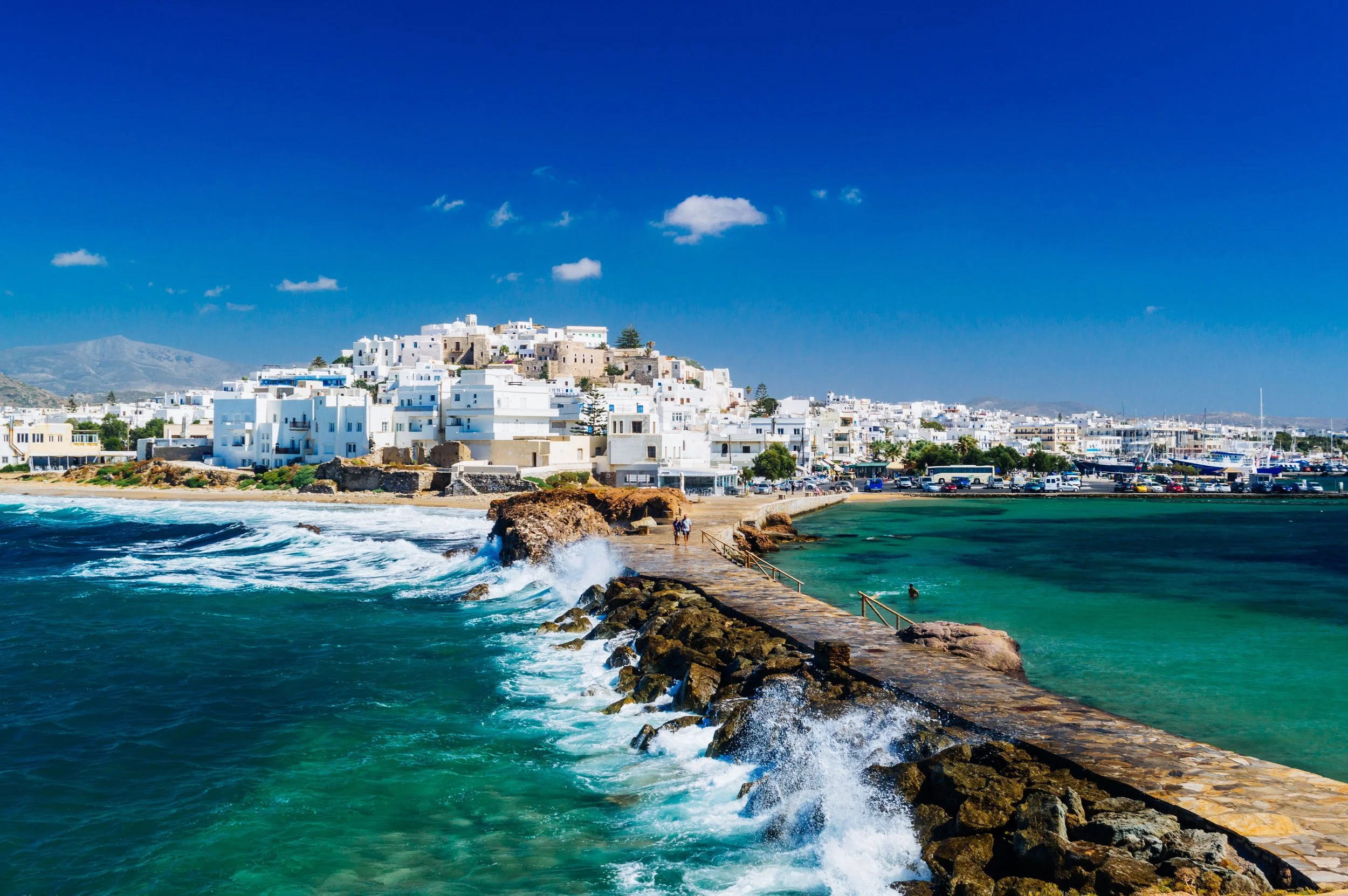
Majestic Naxos beckons
Of all the Cycladic islands, Naxos may be the one that best understands abundance.
It was here that Dionysus, god of wine and ecstatic joy, chose to make his home. Not on glamorous Mykonos or dramatic Santorini, but on fertile, generous Naxos—the largest of the Cyclades, with valleys that still ripple with olive groves, vineyards, and the scent of wild herbs carried on warm wind.
And before Dionysus, there was Zeus. According to myth, the king of the gods was sheltered as an infant in a cave high on Mount Zas, the tallest peak in the Cyclades, hidden there to protect him from his father, Kronos, who devoured his children. That the most powerful deity in Greek mythology was raised here, nursed by the land itself, tells you everything about how the ancient world understood Naxos. It was a place that could sustain even a god.
The island still bears the marks of that generational confidence. High in the marble quarries, the Kouros statues lie half-buried in stone—massive figures abandoned mid-creation centuries ago, their features roughed in but never finished. Whether the sculptors ran out of resources, patience, or purpose is unknown. Standing beside them, you get the strange impression that the island itself decided they were complete enough. That some things don't need to be polished to be whole.
Lower down, where the land softens, Naxos feeds you the way it always has. Rich Naxian cheese made from milk drawn by animals that graze on thyme and wild grasses. Kitron liqueur, distilled from the leaves of the citron tree in a tradition that stretches back generations. Olive oil pressed by methods so old they predate written record. And the Temple of Demeter—goddess of the harvest—still standing among the fields, honoring the fertility that made this island sacred long before tourism arrived.
There is no performance in Naxos. No curated prettiness designed for a camera. Just a deep, unhurried generosity that comes from a place that has always had enough and has never needed to prove it.
Naxos still feeds people the way it always has: lavishly, patiently, without explanation.
Sifnos: Where the Recipe Is the History
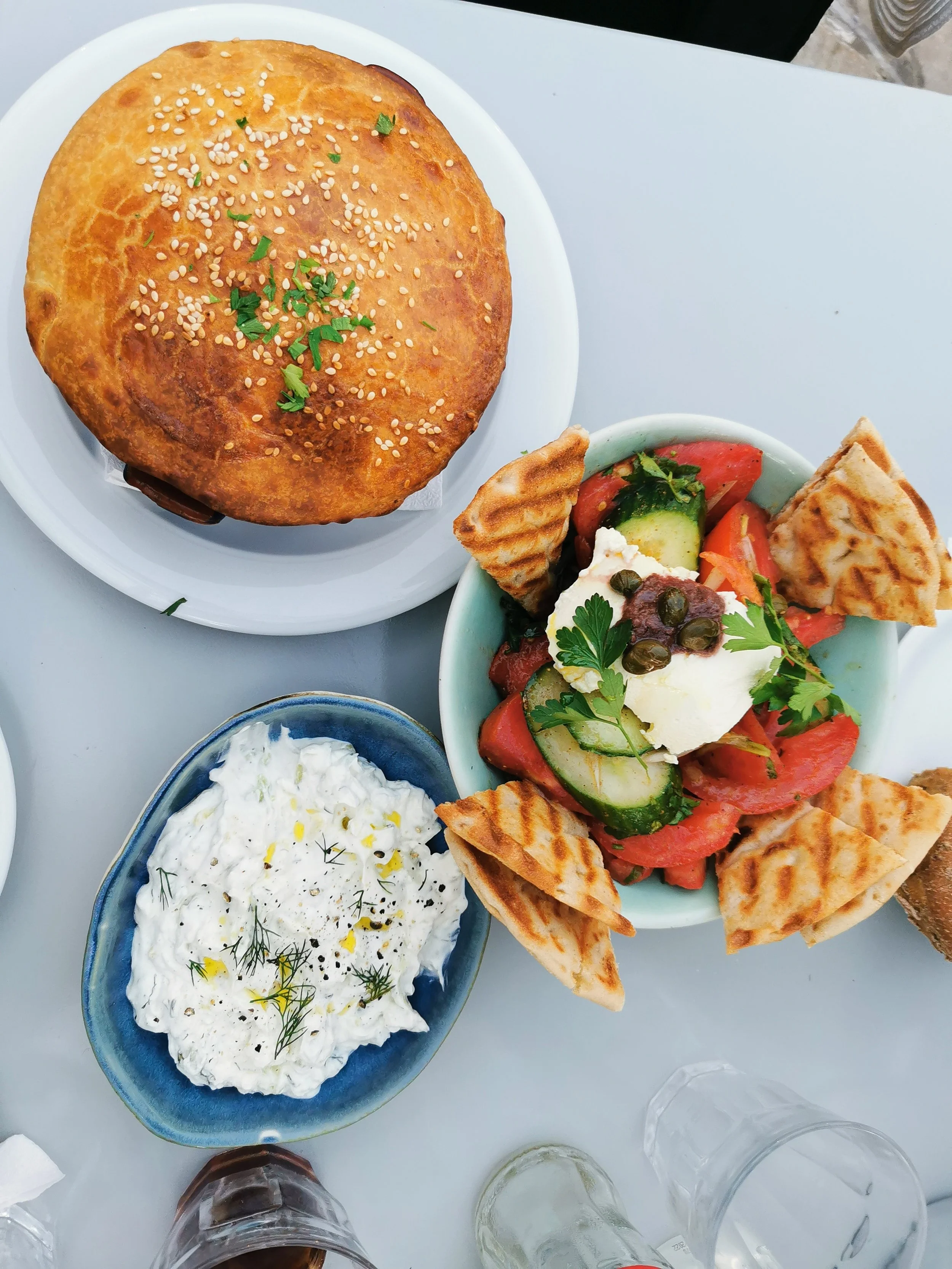
Traditional Sifniot Cuisine
On some islands, history is something you visit. On Sifnos, it is something you taste.
Traditional Sifniot cooking is prepared in the same terracotta casserole dishes that local potters have been shaping from the island's earth for centuries. You cannot separate the food from the vessel, the vessel from the earth, the earth from the island. On Sifnos, everything is continuous.
It was here that Nikolaos Tselementes was born—Greece's most celebrated culinary figure, whose cookbook became the standard reference in Greek kitchens for much of the twentieth century. That he came from Sifnos is not incidental. This is an island that takes food seriously the way some places take architecture or philosophy seriously: as a form of culture worth protecting, refining, and handing down.
But Sifnos is more than what simmers in its kitchens. The Kastro—a medieval hilltop fortress—rises above the eastern coast, its narrow lanes and fortified walls shaped by centuries of pirate raids. Homes were built into the walls. Entrances were narrow and deliberately confusing. Even beauty, on Sifnos, has always had a practical edge. And in Artemonas, elegant Venetian mansions rise among bougainvillea and jasmine - a reminder that the Cyclades are not one thing, but layered by every civilization that sailed through and decided to stay.
Sifnos moves at the speed of a simmering pot. It asks you to match it. To sit longer than you planned, to taste something slowly, to notice that the ceramic bowl in your hands is warm—not only from the food, but from centuries of use.
Milos - The Island That Kept Its Secrets
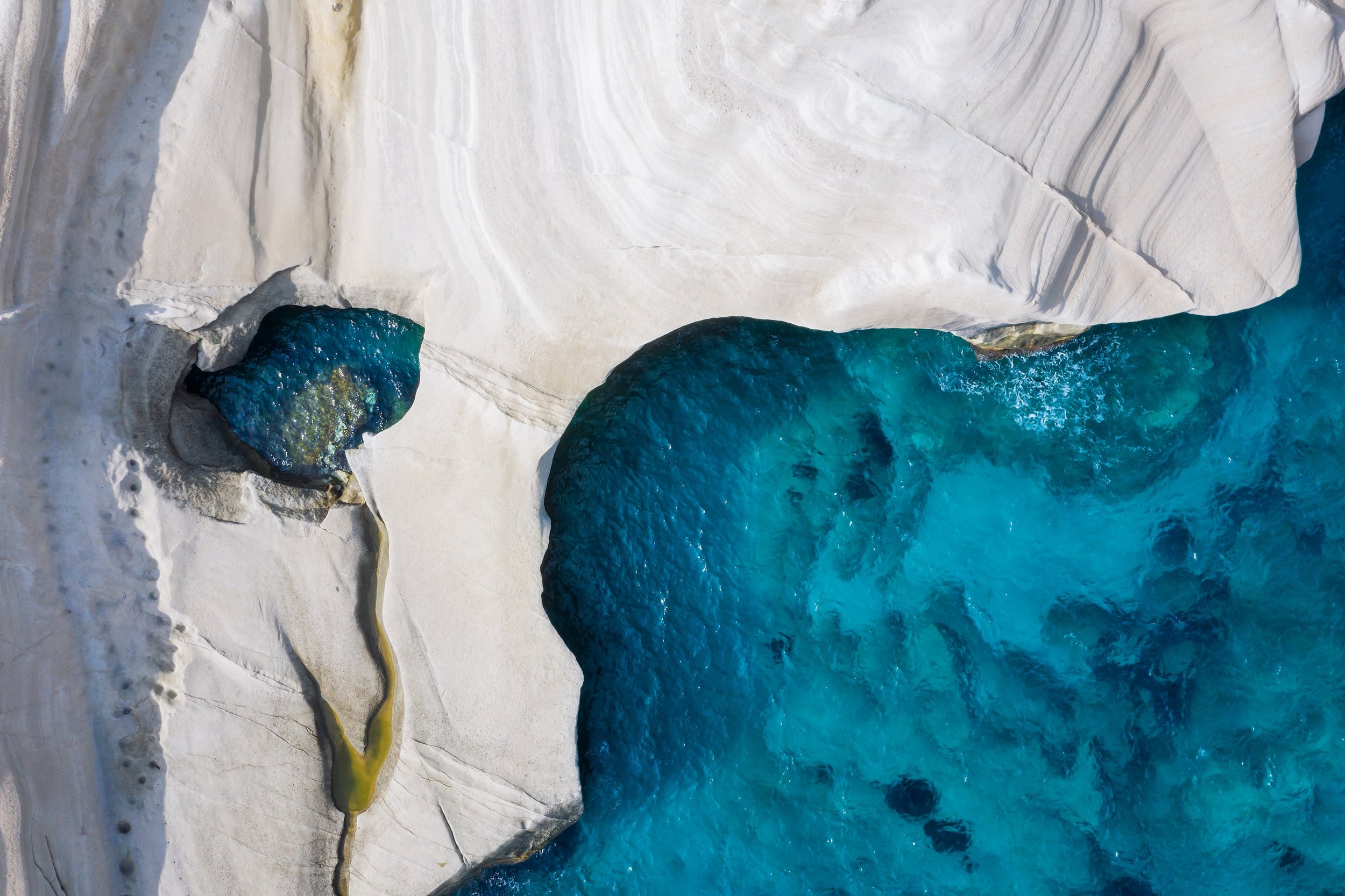
Milos’ Sarakiniko Moonscape
If Naxos feeds you and Sifnos asks you to slow down, Milos asks you to look closer.
It begins at Sarakiniko: white volcanic rock sculpted by wind and sea into formations so smooth and otherworldly they look like the surface of the moon — if the moon were surrounded by water the color of crushed sapphire. There is no sand here, no shade, no concession to comfort. Just stone and light and the sudden awareness that you are standing on something very, very old.
Milos is volcanic to its core, and that geology shaped its destiny. Long before Classical Greece, Neolithic traders recognized the value of the island's obsidian—a dark volcanic glass sharper than any metal tool available at the time. Obsidian from Milos has been found at archaeological sites across the Mediterranean, carried by sailors who navigated open water thousands of years before the myths we know were ever told.
And then there is the discovery that made Milos famous to the modern world. In 1820, a farmer working his field unearthed the Venus de Milo: Aphrodite herself, goddess of love, buried in the volcanic earth of an island that had been keeping secrets for millennia. The statue was removed to the Louvre, where it has remained ever since. But the story lingers here. A goddess, hidden in the ground. A masterpiece, waiting to be found.
At Kleftiko, sea caves and towering rock formations—accessible only by boat—were once used as hideouts by pirates. Arriving by water, you understand why. The stone glows white against turquoise. The caves open slowly, one after another, each more improbable than the last.
And on the final evening, there is the kind of moment that only the end of a journey can hold. A cave winery. A last shared dinner. The particular tenderness of a table surrounded by people who arrived as strangers and are leaving as something else.
Milos reveals itself on its own terms. Which, if you think about it, is the only way to really know anything.
What Slow Travel Finds
What all three islands share is not a postcard aesthetic, though each is staggeringly beautiful in its own way. What they share is a particular pace. A rhythm that predates tourism, productivity culture, and the modern compulsion to optimize every hour.
On Naxos, the Portara—the great marble gate of an unfinished Temple of Apollo—still stands at the edge of the harbor, framing the Aegean the way it has for twenty-five centuries. It is a doorway that leads nowhere and everywhere. A threshold with no walls. The best travel does the same: it doesn't narrow the world, it gives it shape.
What you bring home from a journey like this is not a souvenir. It is a recalibrated sense of time carried quietly in the body, not the suitcase. It is a reminder of what life feels like when you stop rushing through it and let it arrive at its own pace.
The Cyclades have been teaching this lesson for thousands of years.
They are patient enough to teach it again.
An Invitation
If you are drawn to travel that moves slowly, looks closely, and values meaning over momentum—if the idea of simmering pots, volcanic coves, and mythology still alive in the landscape speaks to something in you—we would love for you to join us.
This is a journey for the curious, the unhurried, and the deeply hungry - in every sense of the word.
Savoring the Cyclades | September 13–25, 2026 | $6,495/person
Questions? Call us at 801-718-4121
